

The most reliable way to collect customer reviews is to ask every satisfied customer the day their move finishes, hand them a direct link or QR code to your Google Business Profile, then send one follow-up message a day or two later. Moving companies that automate these requests by email and text gather reviews steadily without extra office work — and route unhappy customers to a fast fix before the feedback goes public.
When someone is choosing a mover, they read reviews before they read anything you wrote about yourself. A short, current stream of positive feedback decides whether you make their shortlist. This guide covers how to collect customer reviews consistently — when to ask, where to send people, how to automate the request, and how to handle the negative review that eventually lands.
Where to collect moving company reviews
Not every review platform carries the same weight for movers. Start where customers actually look, then expand.
| Platform | Why it matters for movers | Priority |
|---|---|---|
| Google Business Profile | Feeds the local map pack and “movers near me” results; the first place customers check | Start here |
| Yelp | Strong for moving searches in many metros; second most-checked | High |
| Social proof for referral and repeat customers | Medium | |
| Industry marketplaces (Angi, Thumbtack) | Reviews sit next to your quote at the moment of decision | Medium |
| Better Business Bureau | Signals legitimacy for high-value and long-distance moves | Situational |
Google Business Profile earns the most visibility per review, so make it the default link you send. Treat the others as places to be present, not where to spend your energy first.
Why customer reviews matter for movers
Reviews do three jobs at once. They improve visibility — Google shows businesses with more recent, higher-rated reviews higher in local results, putting you in front of more people searching for movers. They build trust faster than your own marketing, because customers believe other customers. And they lift conversion: a strong, recent rating means a lead contacts you instead of comparing you against three competitors. A moving company that consistently collects customer reviews compounds all three every month.

When is the best time to ask for a review?
Timing decides your response rate. Ask when satisfaction is highest and the effort is lowest.
- Ask the day the move finishes. Motivation peaks the moment the last box is in and nothing is broken. If the crew confirms the customer is happy, that is the moment to ask.
- Send one follow-up a day or two later. If they were too tired or busy on move day, a short check-in email (“Did everything arrive in good shape?”) reopens the door without nagging.
- Don’t push a frustrated customer. If something went wrong, fix it first — a review request on top of an unresolved problem earns you a public complaint.
Make leaving a review effortless
The gap between “happy customer” and “posted review” is friction. Close it. Send a direct link straight to your Google review form so no one has to search. On-site, a QR code on a card or the crew’s tablet lets a customer post in seconds while they’re still standing in the new place. The fewer taps between the ask and the published review, the more reviews you collect.
Personalize the request
A templated “please review us” underperforms. Reference the actual job — the cross-town move, the piano, the tight staircase the crew handled. A specific, human ask signals you paid attention, and it earns more detailed reviews that read as genuine to the next customer.
How to automate review requests with MoversTech CRM
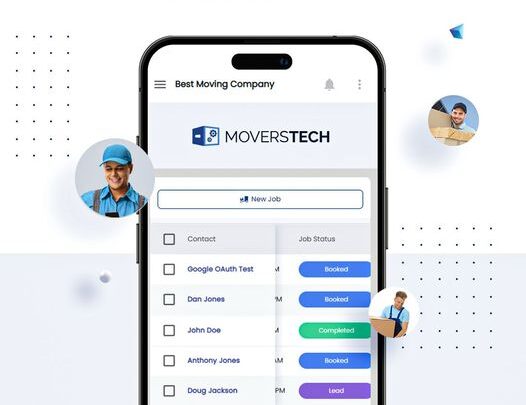
Asking after every single job is the right process and the first thing that slips when the schedule fills up. MoversTech CRM removes the manual step. When a job is marked complete, the system can send a review request by email or SMS with your direct Google link attached — automatically, every time, with no one having to remember.
It also lets you ask the right customers. Route clearly satisfied customers to your public review page, and flag unhappy ones for a personal call first, so problems get solved privately before they turn into one-star posts. Because every request, response, and follow-up is logged in one place — the same place your team already stays connected with customers — you can see which jobs generated reviews and keep the flow steady. Combining review requests with your CRM email marketing for movers turns a scattered afterthought into a repeatable system.
How better service turns into more reviews
Most negative reviews aren’t about the price — they’re about avoidable friction. Tightening the operation is the quietest way to collect customer reviews that are actually five stars:
- Respond to inquiries fast so customers feel prioritized from the first call.
- Quote transparently — surprise charges on the final bill are one of the most common complaints in moving reviews.
- Arrive on time with reliable dispatch and scheduling.
- Communicate proactively with arrival windows and status updates.
- Resolve claims quickly — handling damage claims well can turn a bad experience into a loyal customer.
- Go paperless with digital estimates and e-signatures so the paperwork never becomes the pain point.
Deliver on these and the review largely writes itself. It’s the same foundation behind solid customer service for moving companies.
Most of these come down to running a tighter operation, and that is where the right software pays off: faster responses, accurate quotes, on-time crews, and quick claim resolution all remove the friction that turns into complaints. Deliver on them, and the review largely writes itself — it is the same foundation behind how moving software helps you earn more 5-star reviews. The smoother the job, the better the feedback.
How to handle a negative review
Every mover gets one eventually, and how you respond matters more to future customers than the complaint itself. Reply quickly — a slow response looks like you’re ignoring the problem. Thank the customer, acknowledge the issue, and stay professional, even if you believe the complaint is unfair; arguing in public costs you the next ten customers reading along. Move the conversation offline by leaving your direct contact and offering to make it right. A calm, fast, solution-focused reply often turns a frustrated reviewer around — and when it doesn’t, it still shows everyone else that you stand behind your work.
Turn your reviews into marketing
Reviews you’ve already earned should keep working. Feature your best ones on your homepage and quote them in your ads. Turn strong reviews into social posts. Include recent feedback in your email newsletters. Respond to positive reviews too, not just the negative ones, and keep the profile active by asking after every job — a steady trickle of recent reviews signals to both customers and Google that you’re busy and trusted right now.

Can you pay for reviews? Know the rules
Offering a discount or gift in exchange for a review is against Google’s review policy, and the U.S. Federal Trade Commission’s rule on fake and deceptive reviews prohibits incentivized reviews that aren’t disclosed. Don’t do it — a batch of paid or gated reviews can get your profile penalized and your credibility questioned. What you can do is reward referrals (sending you a new customer) and ask for honest feedback of any kind. Keep the ask about sharing an experience, never about buying a rating.
Start collecting more customer reviews
The moving companies with the strongest reputations aren’t lucky — they ask every happy customer, make it a two-tap process, and let a system handle the follow-up. Build that into your workflow and a steady stream of recent, positive feedback follows. MoversTech CRM helps you collect customer reviews automatically after every job, route unhappy customers to a fast fix first, and keep all your feedback in one place. Book a demo to see how it runs on your own workflow.
Frequently Asked Questions
How do moving companies collect more customer reviews?

Ask every satisfied customer the day their move finishes, give them a direct link or QR code to your Google Business Profile, and send one follow-up message a day or two later. Automating these requests by email or text after each completed job keeps reviews coming without manual work.
When is the best time to ask a customer for a review?
Right after the move is finished, while satisfaction is highest and the experience is fresh. If the customer is too tired or busy that day, a short follow-up email one to two days later is the next-best window.
Can I offer a discount in exchange for a review?
No. Incentivizing reviews violates Google's review policy and the FTC's rule on fake and deceptive reviews. You can reward customers for referrals or ask for honest feedback, but you cannot pay for or gate reviews.
How should a moving company respond to a negative review?
Reply quickly, thank the customer, acknowledge the issue, and stay professional. Offer to resolve it and move the conversation to a phone call or email. A fast, calm response reassures future customers far more than the complaint discourages them.
